Home/ Products / Roots Vacuum Pumps
Circulatory Gas Cooled Roots Vacuum Pump DVQB Serise

Circulatory Gas Cooled Roots Vacuum Pump DVQB Serise

Product Overview

Key Specifications

  • Pumping Speed: 1100to 18000 m³/h displacement across the product line.
  • Ultimate Pressure: Down to 25 Pa (0.25 mbar) for demanding continuous vacuum duty.
  • Motor Power: 4 kW to 250 kW.
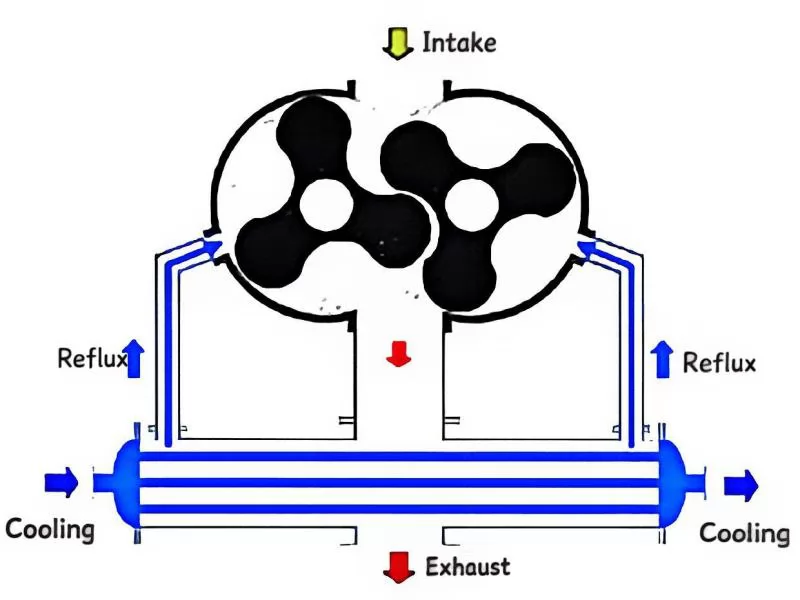
  • Cooling System: Cooling gas flows into the pump chamber from two sides to cool rotors and housing.
  • Shaft Sealing: five‑point mechanical seal provides zero‑leakage capability.

Design & Features

  • Zero Wastewater: Direct atmospheric exhaust with zero wastewater discharge, eco‑friendly operation.
  • Vacuum Unit Combination: Series‑connectable to backing pump; high‑differential design allows smaller backing pump for significant energy savings.
  • Working Range: Wide operating scope,prevents overload and overheating.
  • Pressure Compatibility: supports atmospheric inlet condition.

Typical Applications: Suitable for vacuum distillation, drying, solvent recovery, concentration, CVD, freeze-drying, photovoltaic processing, and industrial furnace processes.
Contact Us Now

Product Introduction

DVQB Circulatory Gas Cooled Roots Vacuum Pump features an added bypass gas‑cooling system. It delivers stable long‑run performance under high pressure‑differential working conditions.
  • • hree‑lobed rotor cooling: Equipped with three‑lobed rotors; recirculated gas cools the medium before gas discharge.
  • • Heat exchanger layout: Heat exchanger is installed on exhaust port or return pipeline for cooling.
  • • Internal cooling design: Cooling gas enters pump chamber from both sides to cool rotors and pump housing, without affecting pumping performance.
  • • Stand‑alone operation: Supports standalone operation.
  • • Multi‑pump series connection: Permits multi‑pump series connection.Can form vacuum units with liquid ring vacuum pumps, dry screw vacuum pumps and other vacuum pumps.


Working Principle

Two three‑lobed rotors inside DVQB air‑cooled Roots vacuum pump are driven by synchronous gears for counter‑rotation. Different from conventional Roots pumps, it is fitted with return cooling ports on pump side walls. Cooled gas is fed into the pump chamber to cool rotors, keeping rotor temperature within allowable range. Thanks to this design, the pump can run at high speed and withstand higher pressure differential without overheating.


Ultimate vacuum

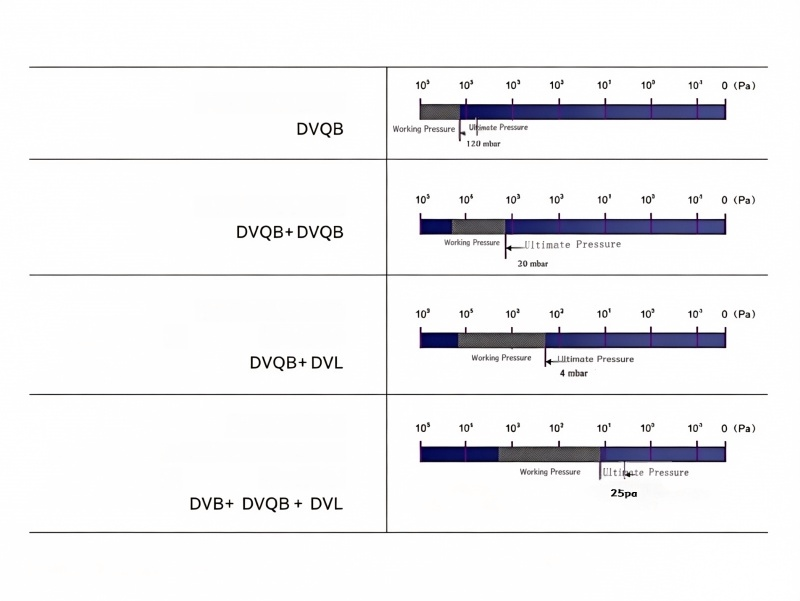
The DVQB Circulatory Gas Cooled Roots Vacuum Pump can start standalone under atmospheric pressure. It can also be fitted with a backing pump; in this case, start the pump after the backing pump evacuates the inlet to a certain vacuum level. Refer to the table below for ultimate vacuum and working vacuum at different stages or when connected in series with water‑ring vacuum pumps.


Design Features

  • • Mechanical shaft seal ensures long service life and superior working performance.
  • • Precision synchronous helical gears enable quiet and reliable operation; drive‑end mounting lowers torque load.
  • • Optional five‑point mechanical seal delivers zero‑leakage performance.
  • • Water‑cooled end cover directly cools seals and extends seal service life.
  • • Integrally‑cast rotor & shaft; oversized shaft reduces impeller damage risk.
  • • Unique three‑lobe rotor design minimizes vibration and noise.


Technical Data

Model Pumping Speed Rotational Speed Matching Motor Inlet Port Size Outlet Port Size Pump Head Weight
DVQB-1100 1100 m3/h 2900 r/min 4~30 kW DIN 125 DIN 125 250 Kg
DVQB-2200 2200 m3/h 1450 r/min 7.5~75 kW DIN 250 DIN 150 660 Kg
DVQB-3200 3200 m3/h 1450 r/min 11~90 kW DIN 300 DIN 200 1100 Kg
DVQB-4400 4400 m3/h 1450 r/min 11~132 kW DIN 350 DIN 250 1400 Kg
DVQB-10000 10000 m3/h 980 r/min 22~250 kW DIN 350 DIN 250 2200 Kg
DVQB-14000 14000 m3/h 1450 r/min 30~250 kW DIN 350 DIN 250 2200 Kg
DVQB-18000 18000 m3/h 1450 r/min 37~250 kW DIN 400 DIN 300 2800 Kg


Product FAQs

1. Can it discharge directly to atmosphere?

Yes. Unlike standard Roots pumps, which must be backed by a fore pump, the DVQB exhausts straight to atmosphere – no wastewater, no liquid disposal, no downstream treatment.


2. What pressure difference and inlet pressure can it handle?

Inlet pressure can theoretically reach atmospheric (101.3 kPa). The maximum allowable pressure difference is set by the motor power, not by the pump itself. Shop test (DVQBL-2000.161 unit): stable operation at ΔP 0.06–0.09 MPa with pump temperature steady at 56–78 °C, confirming high-ΔP reliability.


3. Does it need a backing pump? How can it save energy?

Three configurations: stand-alone, multi-stage in series, or combined with liquid-ring / screw backing pumps. Because the DVQB works at high ΔP, the backing pump can be downsized versus a standard Roots unit – significant energy savings. Unit control logic: open the pneumatic valve → start the backing pump → start the Roots pump when pressure reaches the set point (e.g. P ≤ −90 kPa); reverse order on shutdown. The control panel supports set-point start pressure and interlock protection.

4. How is it cooled? What does the site need to provide?

Gas cooling: a heat exchanger on the discharge / bypass line feeds cooling gas into the pump chamber to cool the rotors (no effect on pumping speed), plus water-cooled end covers that lower seal temperature and extend seal life. Site requirement: cooling water to the exchanger and end covers. Typical configuration (DVQB-1100 project): 7 m² SS304 heat exchanger.

5. What seal options are available? Any leakage risk?

Drive shaft: mechanical seal (standard). Rotor shaft: rotary oil slinger seal, mechanical seal or lip seal (optional). An optional five-point mechanical seal achieves zero leakage – ideal for solvent recovery and clean processes. Seal materials: graphite stationary ring, cemented-carbide rotary ring; FKM O-rings (standard), perfluoro rubber or PTFE (optional) for corrosive / high-temperature duty.
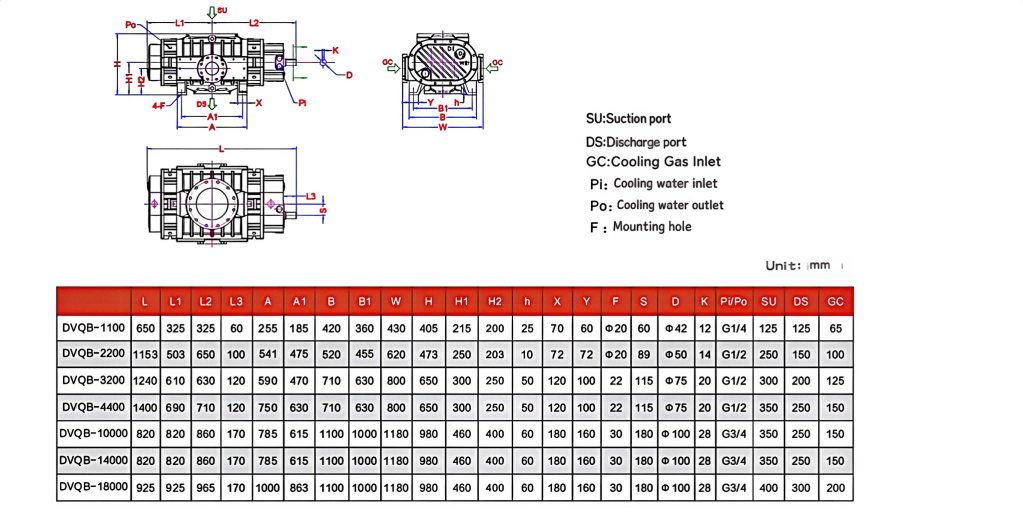

Dimensions

0
Comments
Share your thoughts   Showing 6 of 0 reviews
Leave a Comment
Your email address will not be published. Required fields are marked *
Name can't be empty
Email error!
Submit Comment

Get in Touch with Us

Name can't be empty
Email error!
Message can't be empty
Captcha Error!
Send Your Message

Related Products

Contact Us Now
Name can't be empty
Email error!
Message can't be empty
Send Message