Home/ Products / Vacuum Systems
Liquid Ring Vacuum Systems

Liquid Ring Vacuum Systems

Product Overview

configuration

  • •  induction motor

  • •  liquid ring vacuum pump

  • •  gas‑liquid separator

  • •  common base frame

  • •  heat exchanger

Design & Features

  • •  Supplied as a complete package — separator, heat exchanger, base frame and interconnecting piping reduce on-site
    •  Working liquid (water or process solvent) is circulated, minimising environmental discharge.
    •  Using the pumped medium as working liquid allows recovery of valuable media.

Typical Applications: Chemical Processing、Pharmaceuticals、Lithium‑battery Drying、Metallurgy & New Energy、Vacuum Drying & Concentration.

Contact Us Now

Product Introduction

Water-ring pumps are widely used in chemical and pharmaceutical processing. In standard service the working liquid is discharged directly; where the pumped medium contains organic solvents, toxic or hazardous components, a water-ring closed-loop circulation system is preferred.


Working Principle

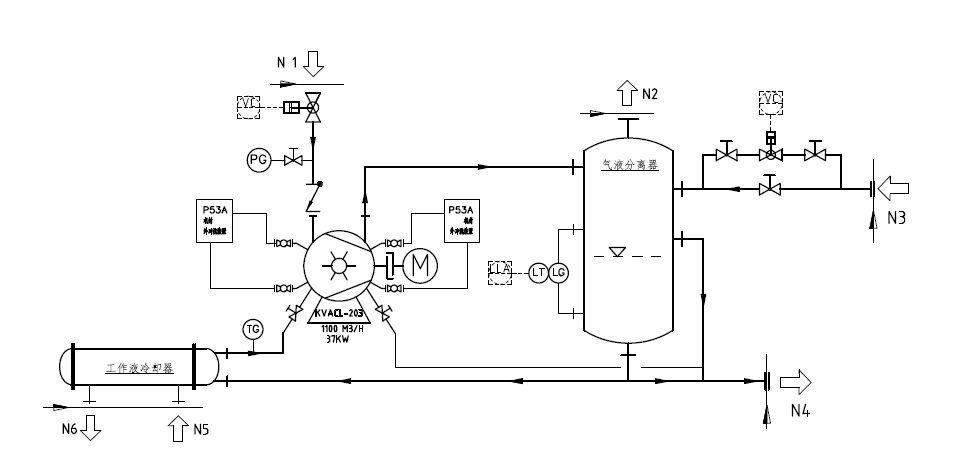
Gas flows into suction port, compressed by liquid‑ring pump and flows with partial working liquid into gas‑liquid separator for phase separation. Gas exits from outlet; working liquid is cooled via heat exchanger and recirculated to pump. The heat exchanger dissipates shaft power loss, sensible heat of hot inlet gas and condensation latent heat of condensable vapours to maintain working liquid at optimal temperature.

Key Advantages

• Supplied as a complete package — separator, heat exchanger, base frame and interconnecting piping reduce on-site • installation time.
• Working liquid (water or process solvent) is circulated, minimising environmental discharge.
• Using the pumped medium as working liquid allows recovery of valuable media.


Standard Composition

• Liquid-ring vacuum pump
• Gas–liquid separator
• Heat exchanger
• Common base frame / skid
• Internal interconnecting piping


Optional Accessories

Suction non-return / pneumatic valve to prevent back-flow on shutdown
Suction vacuum gauge or pressure transducer
Suction filter / strainer
Separator overflow & make-up ports, level gauge (with optional auto level control)
Separator pressure gauge & working-liquid thermometer
Working-liquid booster pump & control valve
Cavitation-protection line
Valves on suction / discharge / working-liquid lines (for shared separators)
Exhaust condenser for recovery of condensable vapours


Product FAQs

1. What information is required to select a liquid ring vacuum system?

Please provide the required operating vacuum, pumping capacity, gas composition, inlet temperature, condensable vapour content, operating duration, cooling-water conditions and installation environment. If the gas is corrosive, toxic or contains solvents, please also provide its concentration and material compatibility requirements. Based on these parameters, we can select the pump size, working liquid, heat exchanger, separator and control configuration.


2. Can the working liquid be recycled in a closed-loop system?

Yes. A closed-loop liquid ring vacuum system circulates the working liquid through a gas-liquid separator and heat exchanger before returning it to the pump. This arrangement reduces water consumption and wastewater discharge. Water, compatible process liquids or selected solvents may be used depending on the pumped medium. In some applications, using the process solvent as the working liquid can also improve solvent recovery.


3. Can a liquid ring vacuum system handle corrosive gases and condensable vapours?

Yes. Liquid ring vacuum systems are particularly suitable for wet gases, condensable vapours and certain corrosive media. The sealing liquid can condense part of the vapour and improve pumping performance. For corrosive service, the pump material, seals, piping and protective coating must be selected according to the gas composition and operating temperature. Optional corrosion-resistant materials and coatings are available after a process review.

0
Comments
Share your thoughts   Showing 6 of 0 reviews
Leave a Comment
Your email address will not be published. Required fields are marked *
Name can't be empty
Email error!
Submit Comment

Get in Touch with Us

Name can't be empty
Email error!
Message can't be empty
Captcha Error!
Send Your Message

Related Products

Contact Us Now
Name can't be empty
Email error!
Message can't be empty
Send Message